Authors and Reviewers
Who writes and checks the questions on this site, what review actually happens today, and why no page here carries an expert byline it has not earned.
Last reviewed August 8, 2026
Test-preparation sites routinely attach invented biographies to their content — a “former Air Force instructor pilot with 3,000 hours” who does not exist, over a stock portrait, with a fabricated LinkedIn. It is an easy way to manufacture authority and it is dishonest, so we do not do it. Everyone below is real, has agreed to be named, and links to a profile you can check for yourself.
Subject-matter contributors
The people who write and check the questions themselves. Everything here is a claim about competence, so each one links to a profile you can open.
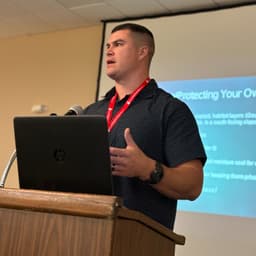
Jordan Schmitt
MQ-9 evaluator and instructor pilot, US Air Force Safety School graduate and qualified mishap investigating officer, currently reading for an M.S. in Aeronautics with an aviation-safety emphasis. Writes and checks the subject-matter content here. Where he wrote an item, he is also the person who checked it — that is an author checking his own work, not independent review, and we would rather say so than let the byline imply two people. Contributes in a personal capacity, unpaid. Nothing on this site is endorsed by, affiliated with or representative of the US Air Force or the Department of Defense.
Technical review across all 11 scored subtests — with one exception the site would rather state than smooth over. 48 Situational Judgment items carry a keying caveat, shown to you beside the mark if you answer one “wrongly”. Choosing the best response to a scenario is a judgement call, and that judgement has not been separately adjudicated, so his sign-off should not be read as vouching for those keys. It is the one place on this site where we mark an answer wrong and tell you in the same breath that we might be. On aviation information, instrument comprehension, situational judgment that is a subject-matter review by someone qualified in the field. On the rest — the vocabulary, mathematics and reading items — it is a careful second reading by a degree-holding generalist, which is worth having and is not the same thing. We separate them because a pilot’s credential does not vouch for an algebra key.
Who operates the site
Listed separately from the contributors above, deliberately. Running the site and knowing the subject are different things, and putting both under one heading would let the second borrow credibility from the first.
John Harry
Operator and developer of AFOQTPracticeTest.net. Builds and runs the site, and is responsible for what it publishes, including its corrections. He does not write or check question content and holds no subject-matter qualification in the tested areas — that work is credited above.
Why the byline is narrow
A reviewer is credited for the subtests they actually read, and for nothing else. Aviation expertise does not qualify somebody to check a vocabulary item, and pretending otherwise would be the same manufactured authority in a more respectable coat. Every item is machine-validated first, and that check is unchanged by who reviews it afterwards.
What we will not do
- Invent an author, a reviewer, a qualification or a period of military service.
- Use a stock photograph as a contributor portrait.
- Create social profiles or
sameAslinks for a person who does not exist. - Emit
PersonorProfilePagestructured data for a placeholder. Our schema layer throws an error if any page attempts it, so this is enforced rather than promised. - Write “expert reviewed” anywhere unless a named expert is visible and their relevance to that exact topic is clear.
- Claim first-hand experience of sitting the AFOQT, or quote a score, a testimonial or a user count.
Who currently writes this material
Content is produced by the site’s editorial team, working from published official information about the exam and from the documented skill descriptions for each subtest. Where a page states a fact about the test, it is recorded in a source register with the source, the date the source itself was published, and the date we last checked it. Where we cannot source a claim, we say so on the page and direct you to your recruiter — the retake page is the clearest example, and it deliberately publishes no attempt limit or waiting period because we have not yet verified those against a current official document.
Drafting uses AI assistance, which is disclosed in full on the AI content policy page. Every consequential decision — answer keys, factual claims, difficulty judgements — requires a person.
How review will work
The workflow exists and is enforced in code today; what is missing is people to occupy the roles. Each item and each consequential page carries three slots: an author, a technical reviewer and an editorial reviewer.
- Technical review confirms correctness within the subject. A mathematics item needs a mathematician; an aviation item needs somebody who can say whether the described attitude is right.
- Editorial review checks clarity, difficulty labelling, tone and consistency with our stated positions.
- Credential verification records when and how a reviewer’s qualifications were checked, alongside their declared conflicts of interest.
A reviewer’s scope is recorded and published. Somebody qualified to review algebra is not thereby qualified to review aerodynamics, and we will not imply otherwise by listing a single generic “reviewer” across unrelated material.
The roles we are looking to fill
We need reviewers with genuine, verifiable backgrounds in assessment design, mathematics, language and reading, physical science, aviation, and accessibility. Aviation is the most acute gap, because Instrument Comprehension and Aviation Information are the two subtests where a plausible-looking error is hardest for a non-specialist to catch.
If that describes you, please get in touch. We will publish your name, your actual qualifications, the scope of what you reviewed, and any conflicts — and nothing beyond what you can substantiate.
How to judge an authors page, including this one
Since we are asking you to weigh our authorship honestly, here is what we would look for on anyone else’s.
Are the people named? “Our team of experts” is not a byline. A name you could search for is the minimum.
Is the credential relevant to the specific material? A qualification in education does not make somebody able to verify an aerodynamics item. Watch for one generic reviewer credited across unrelated subjects — that is the pattern that suggests the role is decorative.
Is the scope stated? A reviewer should be credited with what they reviewed, not with the site in general.
Is the biography specific enough to be falsifiable? Invented credentials tend to be impressive and vague — a service history with no dates, a role with no organisation. Real ones are usually narrower and duller.
Applied to us, the honest answer is that we fail the first test outright and the rest do not yet arise. That is the correct conclusion to draw.
What changes when reviewers are appointed
This page will list them individually with real profiles. Guide pages will carry bylines linked to those profiles. Questions will begin passing the publication gate and the exams will grow towards full length. The methodology page will report the bank’s status as it changes, and the Who / How / Why block at the foot of each page will name the people responsible for it instead of explaining their absence.
Until then, weigh this site accordingly. Our comparison page lists this among our own shortcomings rather than leaving you to discover it.
Who wrote this, how it was made, and why
- Who
- Written by the AFOQTPracticeTest.net editorial team. Editorial pages like this one carry no individual byline; the practice questions are separately reviewed by a named person, whose credentials and the exact scope of his sign-off are on authors and reviewers.
- How
- This page states the current, factual position on authorship. It is generated from the contributor registry in the codebase, which is empty — so the page reports that rather than filling the space.
- Why
- A reader deciding whether to trust practice material needs to know who stands behind it. When the honest answer is "nobody named yet", that is what they should be told.
- Last reviewed
- August 8, 2026. Read our editorial policy or report an error.